If you’ve ever stood next to a fully loaded diesel heavy-duty forklift lifting 20,000 pounds of concrete blocks or steel piping, you can feel it—a subtle, heavy shift in the air, almost like the machine is leaning just a hair under the strain. As a supplier of diesel heavy-duty forklifts, I get asked this question all the time: how exactly does stability change when these machines carry different loads? It’s not just about weight, though that’s a big part of it. Stability in a forklift is a delicate balance of physics, engineering, and how the machine is operated, and every load changes that balance in unique, sometimes surprising ways. Let’s break this down, because it’s the difference between a smooth day in the warehouse or construction site and a preventable accident. Diesel Heavy Duty Forklift

First, I need to start with the basics: what makes a diesel forklift stable in the first place? Unlike cars, which have their weight centered between the front and rear axles, forklifts are designed with a counterweight at the rear end. That counterweight is pure, heavy metal—usually cast iron—that’s built exactly to balance the weight the forks carry at the front. The key here is something called the stability triangle. If you look at a forklift from a side view, the three points of this triangle are the two front tires and the center of the rear axle. For the forklift to stay upright at all times, the combined center of gravity of the machine plus the load has to stay within that triangle at all times. If it slips outside, even by a little, the forklift tips over. That’s the core rule of forklift stability, and every load changes where that center of gravity falls.
Weight is the most obvious factor. A standard diesel heavy-duty forklift, like the models we supply, has a rated load capacity—say, 18,000 pounds at a 24-inch load center. Load center is another critical term I explain to every new operator: that’s the horizontal distance from the face of the forks to the center of the load’s gravity. So if you have a standard pallet of 50-pound bags of flour, that load is 48 inches wide, so its center of gravity is 24 inches from the forks—that’s the rated load center. If you load that same pallet too far back on the forks, so the center of gravity moves to 30 inches from the forks, the forklift can only safely carry around 14,000 pounds, even though the total weight is the same. That’s a huge stability hit. The heavier the load, the more force it exerts pulling the front of the forklift down, which means the counterweight has to work harder to pull the rear down to keep the center of gravity in the triangle. But here’s the catch: diesel forklifts have a fixed counterweight, so if the load’s weight exceeds what the counterweight can balance, the front wheels lift off the ground entirely. That’s a tip, no two ways about it. I’ve seen this happen at construction sites where a new operator loads too many steel beams on one pallet, and the forklift lurches forward, tipping over just enough to bend the mast. It’s avoidable, but only if you understand how weight shifts the center of gravity.
But weight isn’t the only variable. The shape and distribution of the load matter just as much, maybe even more in some cases. Let’s take two loads that weigh the same: 10,000 pounds. Load one is a standard, uniform pallet of packaged goods, stacked evenly so the weight is spread evenly across the forks. The center of gravity is right in the middle of the pallet, 24 inches from the forks, so it balances easily with the counterweight. Load two is a stack of long steel pipes, 40 feet long, sitting on a pallet that’s only 4 feet wide. Even though both weigh 10,000 pounds, the pipes extend way past the width of the pallet and the forks, so their center of gravity is not only further back from the forks—say, 36 inches—but also wider than the forks, pushing the center of gravity to the side of the forklift instead of straight ahead. That creates side load, which is a huge stability risk most people don’t think about. Side load is when the combined center of gravity shifts outside the stability triangle horizontally, not just vertically. For a diesel forklift, which is heavier than electric models, side load is actually amplified because the counterweight is only designed for forward and rear balance, not side to side. I had a client last year who tried to move a load of wooden planks that overhung the forks by 3 feet on each side. The forklift was fine going straight, but when he turned the corner, the side load pulled the center of gravity outside the triangle, and the forklift almost tipped over. It was a close call, and we had to do a full stability test on the machine after that to make sure no structural damage was done. That’s why every operator on our forklifts gets training on load distribution before they even turn the key.
Height also plays a massive role. When you lift a load higher, the center of gravity rises, and that makes the forklift less stable. Think about a seesaw: the further the weight is from the pivot point, the easier it is to tip. For forklifts, lifting a load 15 feet high means the center of gravity is much higher than when the load is at ground level. Even the same weight, same load center, will have less stability at height. That’s why rated load capacities always include a maximum lift height—lift a load higher than that, and the capacity drops, sometimes by thousands of pounds. Diesel forklifts are popular for high-lift applications, like stacking pallets in multi-story warehouses, but operators have to adjust for that lift-related stability loss. I’ve seen this go wrong when someone tries to lift a full load to the top of a rack that’s beyond the machine’s rated height. The center of gravity rises so much that even driving over a small crack in the concrete can shift the balance and cause a tip. It’s not just about the load’s weight at that point—it’s about how high that weight is sitting.
Surface conditions also interact with load to change stability, and this is where the diesel engine’s weight becomes a factor. Diesel forklifts are heavier than electric ones, which can be an advantage on uneven or slippery surfaces, but not when paired with the wrong load. If you’re carrying a full load on wet pavement, the tires have less traction, so turning or stopping too quickly can shift the load’s center of gravity suddenly. The heavier the load, the more momentum it has, and the harder it is to stop without lurching forward or side to side. On soft ground, like a construction site with loose gravel, the forklift’s tires can sink a little, which changes the distance between the axles and the ground, throwing off the stability triangle. If you’re carrying a load that’s already pushing the limits, soft ground can make the center of gravity slip outside the triangle even if you’re going straight. That’s why all our diesel forklifts for construction sites come with heavier-duty tires and load stability monitors that alert operators if the center of gravity is getting too close to the edge of the triangle.
Another often-overlooked factor is dynamic load, which is what happens when the forklift is moving, not stationary. A load that’s stable when parked can shift dramatically when you accelerate, decelerate, turn, or even drive over a small bump. When you accelerate forward, the load’s inertia pushes it back onto the forks, which actually helps stability a little—but if you accelerate too fast, the lurch of the load can throw the whole balance off. When you brake hard, the load’s inertia pushes it forward toward the mast, which can lift the rear wheels or even pull the mast forward if the load is too heavy. Turning is the worst, though. When you turn a corner, centrifugal force pushes the load to the outside of the turn, creating side load. The faster you turn, the more force, and the faster the combined center of gravity shifts outside the stability triangle. I always tell operators of our diesel forklifts: slow down when turning, especially with a full load. Even a small turn at full speed can be enough to tip a machine if the load is large or unevenly distributed.
Now, as a diesel forklift supplier, I’m not just here to explain the science— I’m here to make sure our customers use these machines safely, because that’s what matters most. Over the years, I’ve seen too many forklift accidents that could have been prevented with a little knowledge of how load affects stability. That’s why every forklift we sell comes with a full operator training guide, including hands-on practice with different loads, and our service team does regular stability inspections to make sure the counterweight, mast, and tires are all in good shape.
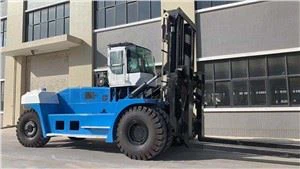
If you’re running a warehouse, construction site, or any operation that relies on diesel heavy-duty forklifts, understanding how load changes stability isn’t just a nice-to-have—it’s a necessity. It means not overloading beyond the rated capacity, distributing loads evenly, keeping loads at safe heights, adjusting for surface conditions, and driving smoothly. The forklift is a powerful tool, but it only works as well as the person operating it, and the key to safe operation is knowing how the load you’re carrying affects its balance.
Rough Terrain Forklift If you’re looking for reliable diesel heavy-duty forklifts that are built with stability in mind, or need training to make your team safer, feel free to reach out and connect with our team to discuss your needs. We work with operations of all sizes, from small local warehouses to large national construction firms, and we tailor our forklift solutions to match the loads and conditions you work with every day.
References
- OSHA. (2023). Powered Industrial Truck (Forklift) Safety Standards. Occupational Safety and Health Administration.
- American Society of Mechanical Engineers. (2020). Standard for Forklift Trucks (ASME B56.1). American National Standards Institute.
- Gadsden, S. A., & Schindler, D. P. (2018). Stability analysis of heavy-duty forklifts under varying load conditions. Journal of Heavy Vehicle Systems, 25(3), 289-312.
- Industrial Truck Association. (2022). Forklift Load Capacity and Stability Guidelines. Industrial Truck Association.
- National Institute for Occupational Safety and Health. (2021). Preventing Forklift Tip-Overs: A Guide for Employers and Operators. Centers for Disease Control and Prevention.
Fujian SOCMA Machinery Manufacture Co., Ltd.
Fujian SOCMA Machinery Manufacture Co., Ltd. is one of the most professional diesel heavy duty forklift manufacturers and suppliers in China. We warmly welcome you to buy customized diesel heavy duty forklift made in China here from our factory. If you have any enquiry about cooperation, please feel free to email us.
Address: Taiwanese Investment Area, Quanzhou, Fujian, China
E-mail: marketing@socmamarketing.com
WebSite: https://www.socma-forklift.com/
